




Many small businesses run on spreadsheets longer than they should. In private healthcare, the same pattern often appears inside prescribing operations.
At the start, a spreadsheet can feel practical. It helps a small team track patients, prescriptions, payments or fulfilment updates. It is flexible, familiar and cheap. But as the clinic grows, the spreadsheet starts to show its limits.
Why spreadsheets stop scaling
The issue is not the spreadsheet itself. The issue is that private prescribing is a live operational workflow, not a static list. Patient intake changes. Consultation records need updating. Prescriptions may require review. Repeat care needs tracking. Pharmacy fulfilment creates a handoff. Patients ask for updates.
When these moving parts are managed manually, every new patient adds pressure. Team members spend time checking information, reconciling updates and chasing missing steps. What looked like a simple admin process becomes a hidden cost.
For growing clinics, this can become a serious barrier. A founder or clinical lead may believe the clinic needs more staff, when the deeper problem is fragmented workflow design. Adding people to a broken process can help temporarily, but it does not solve the underlying issue.
What connected prescribing infrastructure changes
Modern private clinics need connected prescribing infrastructure. That means patient information, prescribing activity, repeat workflows and fulfilment status should be easier to view and manage in one place.
The benefit is not just speed. It is clarity. A connected workflow helps teams understand what has happened, what is waiting and who needs to act next. That matters for patient experience, internal accountability and governance.
It also supports scale. A process that depends on one person’s memory or inbox is vulnerable. A process built into a shared system is easier to repeat, train and monitor. This is especially important as clinics expand into higher-volume prescribing areas or operate across multiple clinicians.
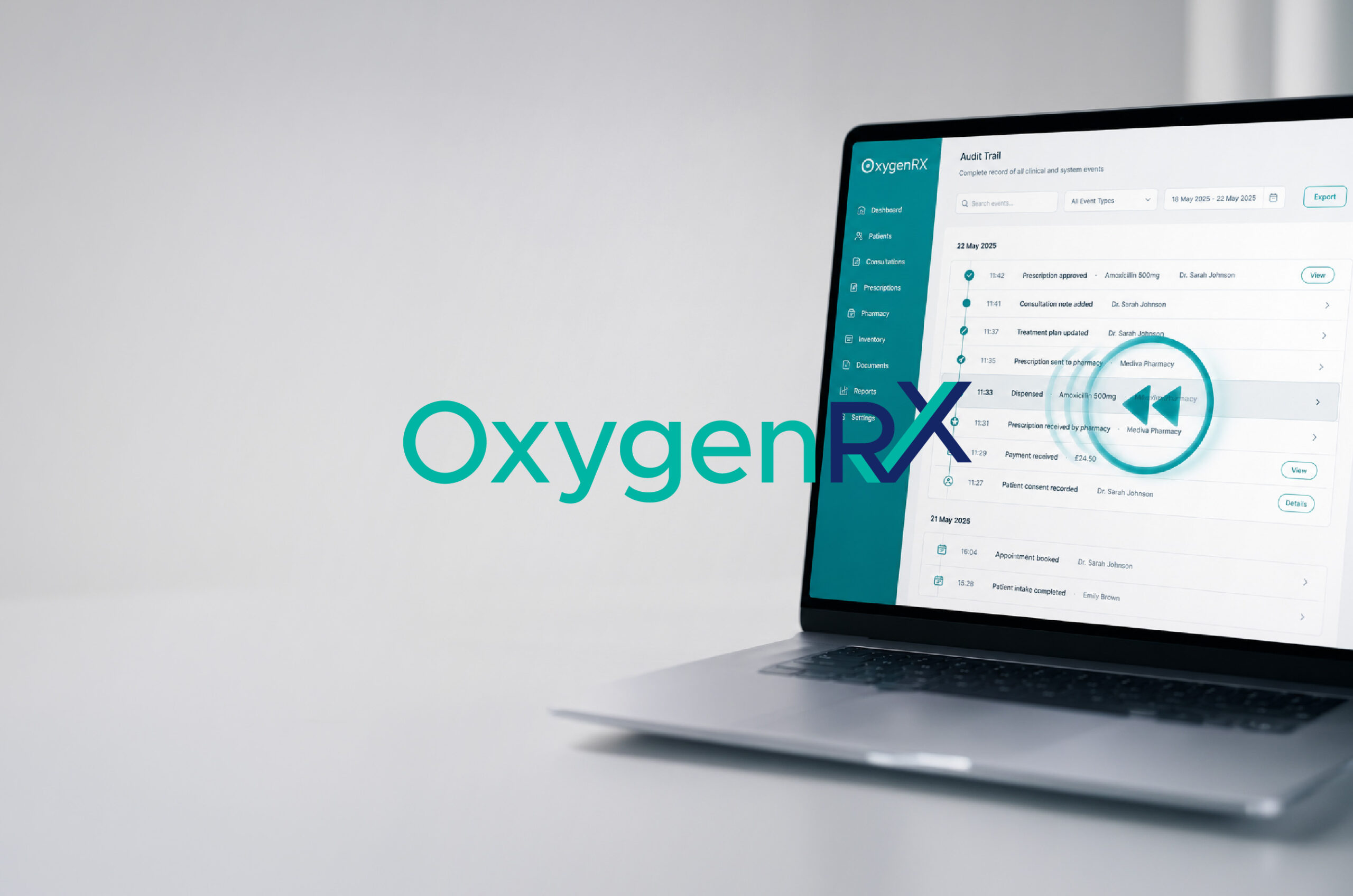
OxygenRx provides UK private prescribing teams with an operating system for records, prescribing workflows, repeat management and fulfilment support. Clinics that are outgrowing manual systems can speak to the OxygenRx team about what a more scalable workflow could look like.
How clinics can spot an infrastructure gap
For owners and managers, the practical question is whether the current process would still work if volume doubled. Could the team find the right record quickly? Would repeat requests be clear? Would fulfilment status be visible? Would a new team member understand what to do without relying on one person’s informal knowledge?
If the answer is no, the clinic may already have an infrastructure gap.
This gap often appears as admin strain before it appears as a strategic issue. Staff may be busy, patients may be waiting for updates and leaders may assume the clinic simply needs more capacity. In reality, the better investment may be a system that removes repeated manual work.
The same thinking applies to governance. A clinic that can see its workflow clearly is better placed to manage risk, train new staff and maintain service quality as it grows.
Why governance matters as demand grows
For healthcare SMEs, the lesson is clear. Growth does not only require more demand. It requires infrastructure that can handle demand without increasing operational risk.
Spreadsheets may help a clinic get started. They should not be the system that holds a growing prescribing operation together.