



For decades, predicting what customers will buy next was more art than science. Store managers relied on gut feeling, last year’s sales figures, and a healthy dose of hope. Order too much stock and cash gets tied up in products gathering dust on shelves. Order too little and customers walk out empty-handed, often straight into a competitor’s store.
Today, that guesswork is being replaced by something far more precise. Artificial intelligence is giving retailers of every size the ability to anticipate demand with a level of accuracy that was simply unimaginable a decade ago — and the businesses that adopt it early are already pulling ahead.
The Real Cost of Getting Demand Wrong
Every retailer knows the pain of a stockout or an overstock, but few stop to calculate what it actually costs the business. Empty shelves don’t just mean a missed sale — they damage customer trust and often push shoppers toward a competitor for good. On the other end, excess stock ties up working capital, increases storage costs, and for perishable goods, results in outright waste.
Traditional forecasting methods — spreadsheets, simple moving averages, and manual adjustments based on last year’s numbers — struggle to keep up with how quickly consumer behaviour shifts today. A viral social media trend, a sudden heatwave, or a competitor’s flash sale can throw off assumptions built on historical averages within days. Retailers need forecasting that adapts in real time, not once a quarter.
Why AI Changes the Equation
Artificial intelligence doesn’t just look at what sold last week. Machine learning systems can process vast amounts of data simultaneously — historical sales, seasonality, local events, weather patterns, promotional activity, and even economic indicators — and identify patterns that would be impossible for a human analyst to spot manually.
Rather than relying on a single formula, AI systems test and combine multiple approaches to figure out which one produces the most accurate prediction for a specific product, store, or category. Retail technology providers such as LEAFIO have built entire platforms around this idea, helping retailers compare a range of demand forecasting models to find the one that best fits their sales patterns, rather than forcing every product category into the same generic forecast.
This matters because no two retail businesses forecast demand in the same way. A grocery chain managing thousands of perishable SKUs across dozens of stores has very different requirements from a specialty electronics retailer with a handful of high-value products. AI-driven forecasting allows each business — and often each product category within that business — to be modelled according to its own specific demand drivers.
From Reactive to Predictive
The real shift AI brings isn’t just better numbers — it’s a change in how retailers operate. Instead of reacting to what already happened, businesses can now act ahead of demand.
This shows up in a few practical ways:
- Smarter replenishment. Instead of manually reviewing stock levels and placing orders based on rough estimates, AI systems can trigger automatic replenishment the moment predicted demand crosses a threshold, keeping shelves stocked without tying up excess capital.
- Sharper promotional planning. AI models can factor in how a promotion is likely to affect demand for related products, not just the item on offer, helping retailers avoid both understocking a promoted line and being caught out by a knock-on surge elsewhere.
- Better seasonal preparation. Retailers no longer have to rely purely on last year’s holiday sales to plan this year’s stock. Models can account for shifting trends, economic conditions, and even early-season signals to refine forecasts as the peak period approaches.
- Reduced waste. For retailers dealing in fresh or perishable goods, more accurate short-term forecasting directly reduces the amount of stock that goes unsold and has to be written off.
Not Just for the Big Players
It’s tempting to assume this level of sophistication is reserved for large retail chains with dedicated data science teams. That’s changing quickly. As AI-powered forecasting tools become more accessible and easier to integrate with existing point-of-sale and inventory systems, small and medium-sized retailers are increasingly able to benefit from the same predictive capabilities as much larger competitors.
For an SME, this can be transformative. A smaller retailer typically has less room for error — less capital to absorb the cost of overstocking, and less resilience to bounce back from a stockout during a critical sales period. Getting forecasting right isn’t a nice-to-have; it can directly determine whether a season is profitable or not.
Cloud-based platforms have lowered the barrier to entry considerably. Where predictive analytics once required significant upfront investment in infrastructure and specialist staff, many solutions today are offered as subscription services that plug into a retailer’s existing systems, delivering forecasts without the need for an in-house data science function.
What Retailers Should Consider Before Adopting AI Forecasting
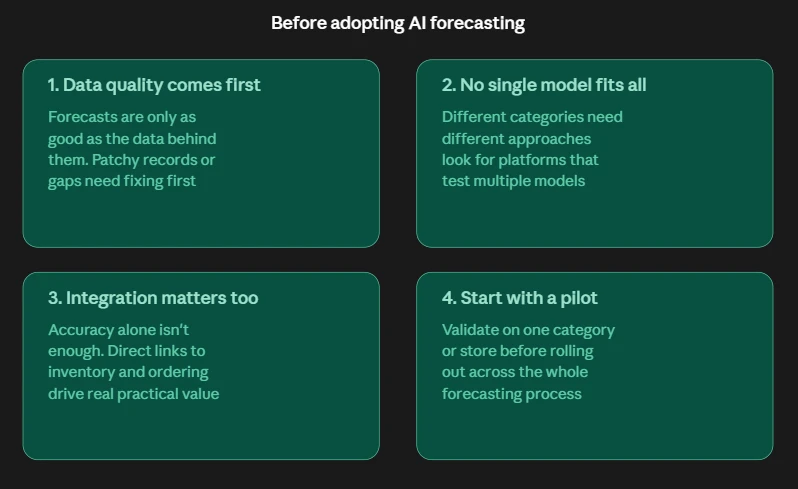
Bringing AI into demand planning isn’t simply a case of flipping a switch. A few things are worth thinking through before making the leap:
- Data quality comes first. AI forecasting is only as good as the data feeding it. Retailers with patchy sales records, inconsistent product categorisation, or gaps in historical data will need to address these issues before a model can produce reliable predictions.
- No single model fits everything. As highlighted earlier, different product categories often respond better to different forecasting approaches. A retailer evaluating AI solutions should look for platforms that can test and apply multiple models rather than a one-size-fits-all formula.
- Integration matters as much as accuracy. A highly accurate forecast is only useful if it can be acted on quickly. Systems that integrate directly with inventory and ordering processes tend to deliver far more practical value than standalone forecasting reports that still require manual follow-up.
- Start with a pilot. Rather than overhauling the entire forecasting process at once, many retailers find it more effective to start with a single category or store to validate the results before scaling up.
Looking Ahead
The gap between retailers using AI-driven forecasting and those still relying on spreadsheets and gut feel is only going to widen. As more data sources become available — from real-time foot traffic to social sentiment — the accuracy of predictive models will keep improving, and the retailers who have already built the infrastructure to use them will be best placed to take advantage.
For SMEs in particular, the message is clear: predicting demand accurately is no longer a luxury reserved for enterprise retailers with deep pockets. The tools have become accessible, the technology has matured, and the businesses that embrace it now are giving themselves a genuine competitive edge — not by working harder, but by knowing, with far greater confidence, what their customers want before they even ask for it.