

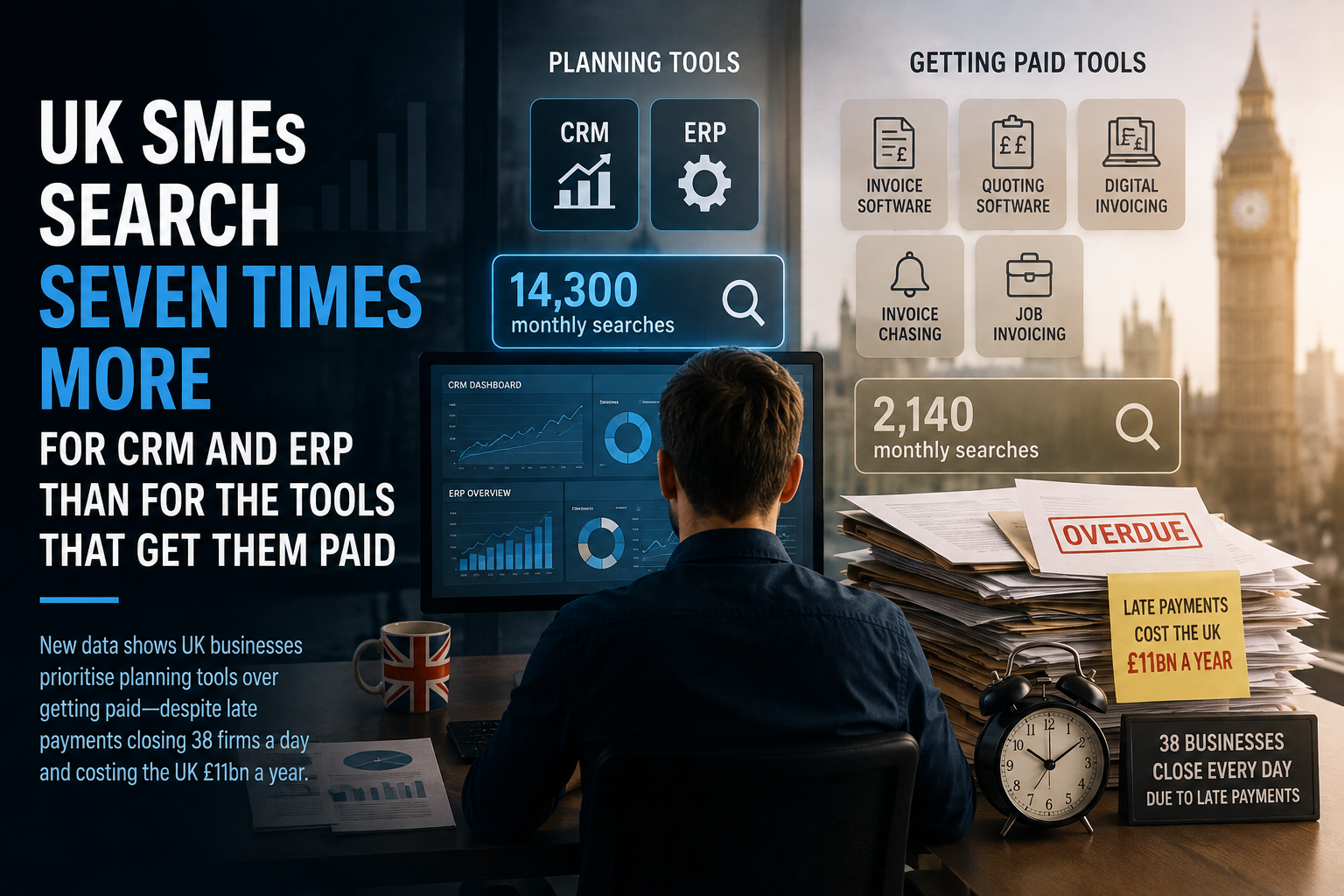



Small and medium-sized firms in Britain still type planning-suite names when cash is the problem that keeps them awake. A new analysis of UK search behaviour finds that demand for CRM and ERP software is running about 6.7 times higher than demand for the tools that raise, quote and chase an invoice, even as late payment continues to close businesses every day.
Klipboard, a field service management platform, analysed UK monthly search volume through August 2026. Combined demand for six cash-cycle terms (invoice software, quoting software, quote software, digital invoicing, invoice chasing and job invoicing) sits at about 2,140 monthly searches. CRM software and ERP software together draw about 14,300. Invoice software is the largest getting-paid term at around 1,200, still below CRM software at 8,900 and below ERP software at 5,400. Brand terms were not included. The volumes are Ahrefs monthly estimates, not actual click counts. The 6.7 times ranking still holds. Invoice software is down 24.1% year on year (1,065 against 1,403). Getting-paid search is not rising.
That mix should worry any owner who has finished a job and then waited to get paid. The government says late payments cost £11bn a year and close 38 businesses a day. The Small Business Protections Bill (Commercial Payments Bill) was introduced on 19 May 2026. It is not yet law. It includes a 60-day cap on large firms paying smaller suppliers. A cap cannot start until the invoice exists.
The Federation of Small Businesses Small Business Index for Q1 2026, published on 7 April 2026, found that 69% of small firms surveyed in March 2026 said they were affected by late payments. The Bill and the FSB finding describe the harm. The search ranking describes what firms think the software fix looks like. Those two pictures do not match.
Gabriel Cohen, VP of Sales Strategy at Klipboard, said a law in Parliament and a planning dashboard are not substitutes for raising the invoice.
“A late-pay Bill in Parliament does not collect a debt. What shows up in the search data is that getting-paid tools are a fraction of the demand for enterprise suites. For a contractor, the cheap win is closing the loop from site to invoice, not buying another dashboard.”
For a typical SME, work is done, a photo sits on a phone, and the invoice goes out late, so the 60-day clock never starts. Invoice chasing draws about 30 UK monthly searches on this cut. Job invoicing draws about 10. Digital invoicing draws about 50. Quoting software, at about 700, is the strongest cash-cycle term after invoice software, and it is still a fraction of CRM demand.
The Insolvency Service recorded 3,841 construction company insolvencies in the 12 months to 31 July 2026, 17% of cases with an industry captured, the most of any industry. Wholesale and retail, including vehicle repair, was second with 3,422 cases (15%). July 2026 construction insolvencies were 343 (not seasonally adjusted, provisional), still the highest monthly sector total.
Cohen tied the insolvency ranking to the search bar.
“When construction is top of the insolvency list, the search bar tells you what firms think the fix is. They are still typing CRM and ERP far more than invoice or quote. That is a planning-system habit. The expensive failure is usually the last mile: the job that was done, the photo that sat on a phone, the invoice that went out late.”
Field service management software, at about 1,000 UK monthly searches, is a labelled baseline only. It is not part of the 6.7 times ratio. The original finding is the cash-cycle basket versus CRM and ERP, set beside a Bill that has entered Parliament, a government estimate of £11bn and 38 closures a day, and an FSB survey in which 69% of small firms reported late-pay harm.
Until the Bill is law, and until the invoice exists, the 60-day cap is a future rule, not cash in the bank.