




In 2018, researchers discovered that cancer cells can 'pre-programme' distant organs for metastasis by sending molecular messages through tiny bubble-like packages, fundamentally changing how we understand tumour spread. This finding exe...
30th October 2026 · 4 min read
Business Advice
How Structural Food Tray Design Can Help Food Businesses Reduce Packaging Components
Posted on 26th November 2026 · 4 min read
How Structural Food Tray Design Can Help Food Businesses Reduce Packaging Components
For small and medium-sized food businesses, packaging costs go beyond the price of the container. Absorbent pads, inserts and other supplementary items must also be purchased, stored, handled and disposed of. In busy takeaway kitchens and supermarket food counters, these steps can affect daily operations.
One way to simplify the process is to examine whether the container itself can perform functions currently handled by separate components. Structural tray design offers possibilities, although every change must still meet the food’s protection, handling and distribution requirements.
Can Tray Design Reduce the Need for Absorbent Pads?
Absorbent pads help manage liquid released by some fresh foods during storage and display. They can be important for product presentation and hygiene, but also add another material and a separate packing step.
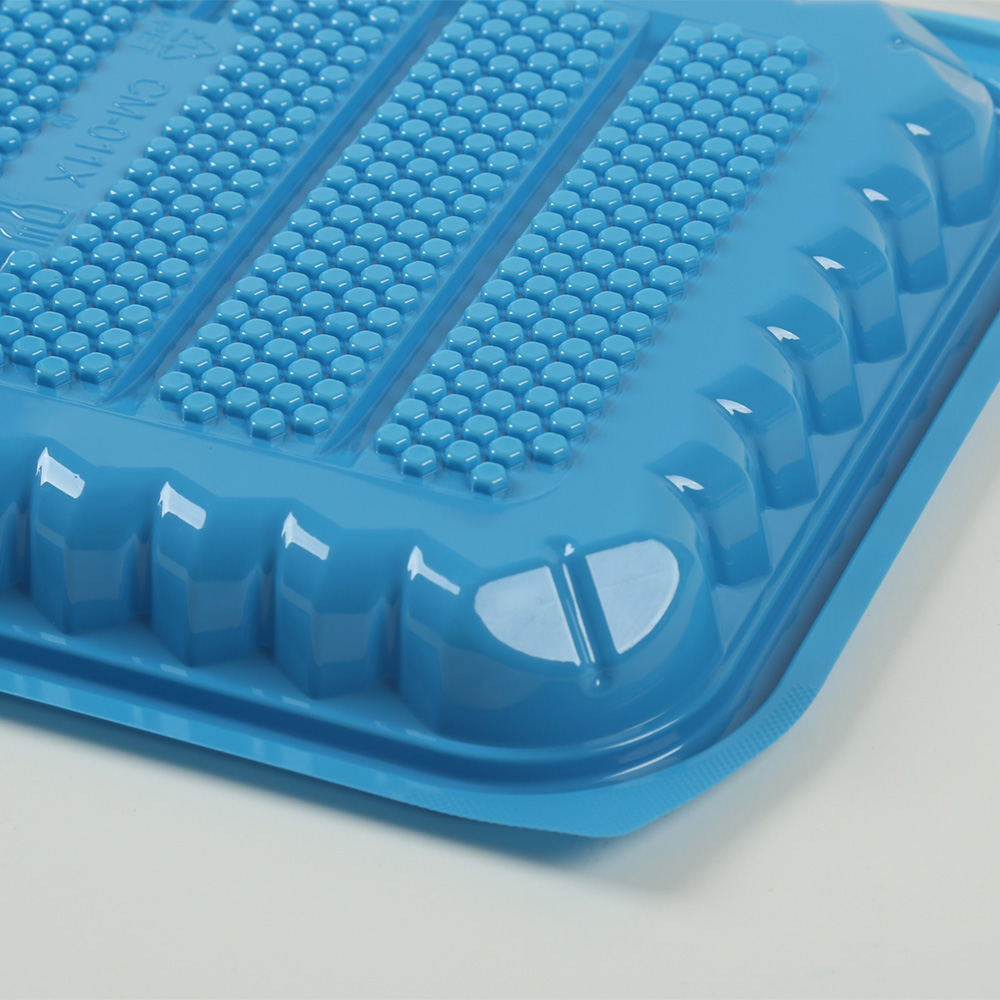
An alternative is to design the tray with recessed collection areas, raised food-support surfaces or drainage channels. These features can direct liquid away from the main food-contact surface, reducing the likelihood that food sits in accumulated moisture.
There is, however, a crucial difference between collecting and absorbing liquid. A recessed tray holds liquid in a designated area; it does not immobilise it. Performance depends on the food type, volume of liquid released, storage period, container orientation and transport conditions.
For suitable products and handling conditions, these structures may reduce or remove the need for a separate pad. They are not a universal replacement, particularly for foods releasing substantial amounts of liquid or packages likely to be tilted during delivery. Operators should assess the complete packaging system under realistic conditions before making changes.
The Operational Value of Fewer Components
A separate absorbent pad creates work beyond its purchase price. Staff may need to position it before filling the container, while managers must maintain stock and allocate storage space.
If a tray can safely provide the required liquid-management function on its own, removing that step may simplify packing and inventory management. This can be useful for smaller businesses where employees handle food preparation, packing and customer service in quick succession.
Yet fewer components do not automatically mean lower costs. A redesigned tray could require additional material, more complex tooling or a higher unit price. Businesses should compare the total cost of the container and accessories, handling time, storage needs and performance throughout distribution.
A small packing trial can make this comparison more useful. Operators can record the number of components used per order, time required to fill and close each package, and any leakage or presentation problems reported after delivery. Comparing these observations across existing and proposed formats is more reliable than assuming that a one-piece design is automatically cheaper.
Structure Also Affects Presentation and Handling
Liquid control is only one aspect of food tray design. Geometry, wall thickness, rim shape and dimensional consistency influence stacking, lid fit, rigidity and how the product appears on display.
Different foods create different priorities. Sushi packaging often emphasises visibility and presentation, while deli containers may need different depths and closure configurations. Foods containing sauces can create additional leakage concerns.
The practical starting point is therefore the application, not simply a particular material or tray style.
Manluen Pack, a food packaging supplier with its own production facilities, is exploring how structural features such as recessed areas, drainage paths and material distribution can support the performance of rigid food trays. Its wholesale range includes sushi trays, clamshell containers, bento boxes and deli containers for foodservice and retail uses.
This illustrates why packaging suppliers need to consider how a container will be filled, closed, stacked, transported and displayed, rather than evaluating each design feature in isolation.
Material Efficiency Requires a Complete View
Removing a separate component may reduce handling requirements and, in certain applications, material consumption. But the benefit must be assessed against any additional material used in the redesigned tray.
Nor does a simpler structure automatically make a package recyclable. Actual recovery depends on material composition, food contamination and the availability of local collection, sorting and reprocessing systems.
Likewise, a tray that uses fewer separate pieces may still contain more total material. Assessing both the number of components and the overall weight of the package can help businesses distinguish a genuine reduction from a design change that simply shifts material from one part to another.
For SMEs making packaging decisions, useful questions include whether a design maintains food protection, whether it performs during transport, and whether its overall cost and material use improve compared with the existing arrangement. Any claimed reduction should be supported by an application-specific comparison.
Choosing Packaging That Works in Practice
Before switching formats, food businesses should test samples with the foods they actually sell. Liquid release, stacking conditions, lid security, storage duration and delivery movement can all reveal issues that are not obvious from a product photograph.
It is also worth consulting staff who handle the packaging every day. A tray that performs well in a controlled test may still be difficult to separate from a stack, awkward to close quickly or inefficient to store. These practical observations should inform any purchasing decision.
Structural design will not eliminate every accessory. Used appropriately, however, it can help operators identify unnecessary components and choose packaging that balances product protection, day-to-day efficiency and material use.
Popular Articles




The Biggest Myths Founders Believe About Scaling
17th November 2026 · 4 min read
Why Your Business Strategy Could Fail Tomorrow: Scott Steinberg on Preparing for Disruption
17th November 2026 · 4 min read
The Biggest Legal Issues Seen During Corporate Growth
2nd November 2026 · 2 min read
Five Questions Every Entrepreneur Should Ask Before Setting Another Business Goal
25th November 2026 · 3 min read
Article Categories
You Might Also Like
Advances in Cellular Signaling: Key Biomolecular Discoveries Shaping Life Sciences

Brand vs Performance: How MMM Measures the Effects That Last
Brand media gets cut first because most measurement only captures what happens in the few weeks after an ad runs. On that window, performance channels almost always look better. Marketing mix modeling can correct the picture by measuring two thing...
3rd November 2026 · 4 min read
Five CRM Mistakes That Cost UK SMEs Real Pipeline
Many British smaller businesses buy customer relationship software with high expectations. They expect a system that tracks leads perfectly and makes sales simple. However, the reality inside many sales operations looks quite different, as platfor...
31st July 2026 · 4 min read