




For any small or medium-sized business, sales management is a critical process that directly drives business growth. One of the biggest challenges SMEs face is a lead management process scattered across disconnected tools. A form here, a spreadshe...
31st August 2026 · 4 min read
Business Advice
How to Do SEO for SaaS: Strategy Guide and Top Agencies
Posted on 20th November 2026 · 7 min read
Software buyers rarely meet a SaaS brand on its homepage first. They compare options in Google, skim an AI summary, ask a chat assistant for a shortlist, then visit two or three vendor sites. In the UK, Ofcom’s 2026 Adults’ Media Use and Attitudes report found that 75% of online adults read AI-generated search summaries at least sometimes, and 42% read them often or always.
That makes SaaS SEO a single programme with two outputs: pages that rank in Google, and a brand that AI answers describe accurately. This guide sets out a five-step strategy, explains when an agency makes sense, and compares specialist teams that can help.
Key Takeaways
- SaaS SEO starts with buyer demand, not keyword volume: map searches to the evaluation stage before writing anything.
- Technical groundwork decides whether search engines and AI crawlers can read your pages at all.
- Google states that optimising for its generative AI features is still SEO, and it ignores llms.txt files.
- Third-party mentions in buyer guides and comparisons shape how AI answers describe your product.
- Measure demos, trials and pipeline alongside rankings and AI impressions, and keep those numbers separate.
Why SaaS SEO Needs Its Own Strategy
SaaS products are intangible, priced by subscription and bought by committees. A buyer may search for a category (“customer onboarding software”), a problem (“reduce churn in the first 30 days”), a comparison (“X vs Y”) and finally a brand name. Each stage needs a different page.
SaaS websites also carry technical quirks. Marketing pages, documentation, a help centre and the app itself often share one domain, and JavaScript-heavy frameworks can hide content from crawlers. A generic SEO checklist misses both problems.
Step 1: Map Search Demand to the Buyer Journey
Start with your sales and support teams rather than a keyword tool. Ask which questions come up before a demo, which competitors prospects mention, and which objections stall deals. Those answers become your priority topics.
Then group searches into three tiers:
- Bottom of funnel: comparison pages, “alternatives” pages, pricing explanations and use-case pages. These convert best and deserve attention first.
- Middle of funnel: guides that show how to solve the problem your product addresses, with your product as one sensible option.
- Top of funnel: educational content that builds category authority. Useful, but slowest to produce revenue.
Google’s AI features break one question into several related searches behind the scenes. A page that answers the follow-up questions a buyer would ask has more chances to be retrieved than a page built around one exact phrase.
Step 2: Fix the Technical Foundations
Technical SEO is set up once and then maintained. Check these points before investing in content:
Site structure. Keep the blog and resources in a subfolder (yourdomain.com/blog) rather than a subdomain, and reserve subdomains for the app and documentation where that suits your engineering setup.
Page experience. Google’s Core Web Vitals thresholds for a good experience are Largest Contentful Paint under 2.5 seconds, Interaction to Next Paint under 200 milliseconds and Cumulative Layout Shift under 0.1. Third-party scripts such as chat widgets and tag managers are a common cause of slow interaction on SaaS marketing sites.
Rendering. Serve important content in the initial HTML through server-side rendering or static generation. Many AI crawlers do not run JavaScript, so content that only appears after scripts load may never be read.
Crawler access. Review robots.txt with your developer. OpenAI documents separate crawlers: OAI-SearchBot fetches pages for ChatGPT search, while GPTBot relates to potential model training. You can allow the first and block the second. In Google Search Console, the Search generative AI control lets a site opt out of AI Overviews, AI Mode and generative features in Discover; sites are included by default.
Structured data. Use Organization, Product and Article schema where the page content supports it. Note that FAQ rich results stopped appearing in Google Search on 7 May 2026, so FAQ markup no longer produces the expandable result it once did.
Step 3: Build Content That Answers Buying Questions
Google’s guide to optimising for generative AI features, published in May 2026, warns against commodity content that repeats what is already available. It also states that you do not need llms.txt files, special AI markup or content split into tiny chunks to appear in AI Overviews or AI Mode. So rather than running separate playbooks for SEO, GEO and AEO, treat them as one content strategy built on genuinely useful pages.
For SaaS teams, that points to content only your company can write:
- Product-led tutorials with real screenshots and workflows.
- Comparison pages that state honestly where a competitor is the better fit.
- Benchmarks or survey data from your own customer base, published with permission.
- Named authors with relevant experience, such as a product manager or solutions engineer.
Put a direct answer near the top of each section, use tables for genuine comparisons, and update key pages when pricing, features or integrations change.
Step 4: Earn Mentions on Sites Buyers and AI Answers Trust
AI assistants often build shortlists from buyer guides, review platforms, industry publications and community discussions. If your product is missing from those sources, or described inconsistently, AI answers may leave it out or describe it inaccurately.
Practical steps include:
- Keeping your product description, pricing model and category consistent across your site, G2, Capterra, LinkedIn and partner directories.
- Pitching original data or expert commentary to publications your buyers read.
- Asking satisfied customers for honest reviews on the platforms prospects use.
- Joining relevant communities openly, with your company affiliation disclosed.
Track mentions and linked citations separately. A mention names your brand; a citation also links to a page. Neither proves a visit or a sale.
Step 5: Measure Pipeline, Not Just Rankings
Build a scorecard that keeps visibility and revenue apart:
| Measure | Source | What it tells you |
| Clicks and impressions | Google Search Console performance report | Classic search visibility and visits |
| Generative AI impressions | Search Console generative AI report | Appearances in AI Overviews and AI Mode, by page and country |
| AI citations | Bing Webmaster Tools AI Performance | How often pages are cited in Copilot and Bing AI answers |
| Prompt checks | Manual monthly sampling | How assistants describe your product |
| Demos, trials and pipeline | CRM and analytics | Commercial outcomes |
Google’s generative AI performance report rolled out to all websites worldwide by 31 August 2026. It shows impressions but no click or query data, so treat it as an exposure measure. Bing’s AI Performance report adds grounding queries, a sample of the phrases its AI used to retrieve cited content, and its Topics Portfolio beta, launched in October 2026, lists queries where other sites are cited but yours is not.
In-House Team or Agency?
An in-house team keeps product knowledge close and suits companies with steady content needs and engineering support. A freelancer can handle a defined task, such as a technical audit or a batch of comparison pages. An agency makes sense when you need technical SEO, content, digital PR and AI search work run as one programme, or when you need results faster than you can hire.
When comparing agencies, ask how they report on pipeline, which AI platforms they track, who will run your account day to day, and who owns the content and links if you leave. Be wary of guaranteed rankings or guaranteed AI citations: no supplier controls either.
Who Can Help: Specialist SaaS SEO Agencies
The agencies below focus on B2B SaaS and technology companies and cover both Google and AI search.
1. MADX Digital
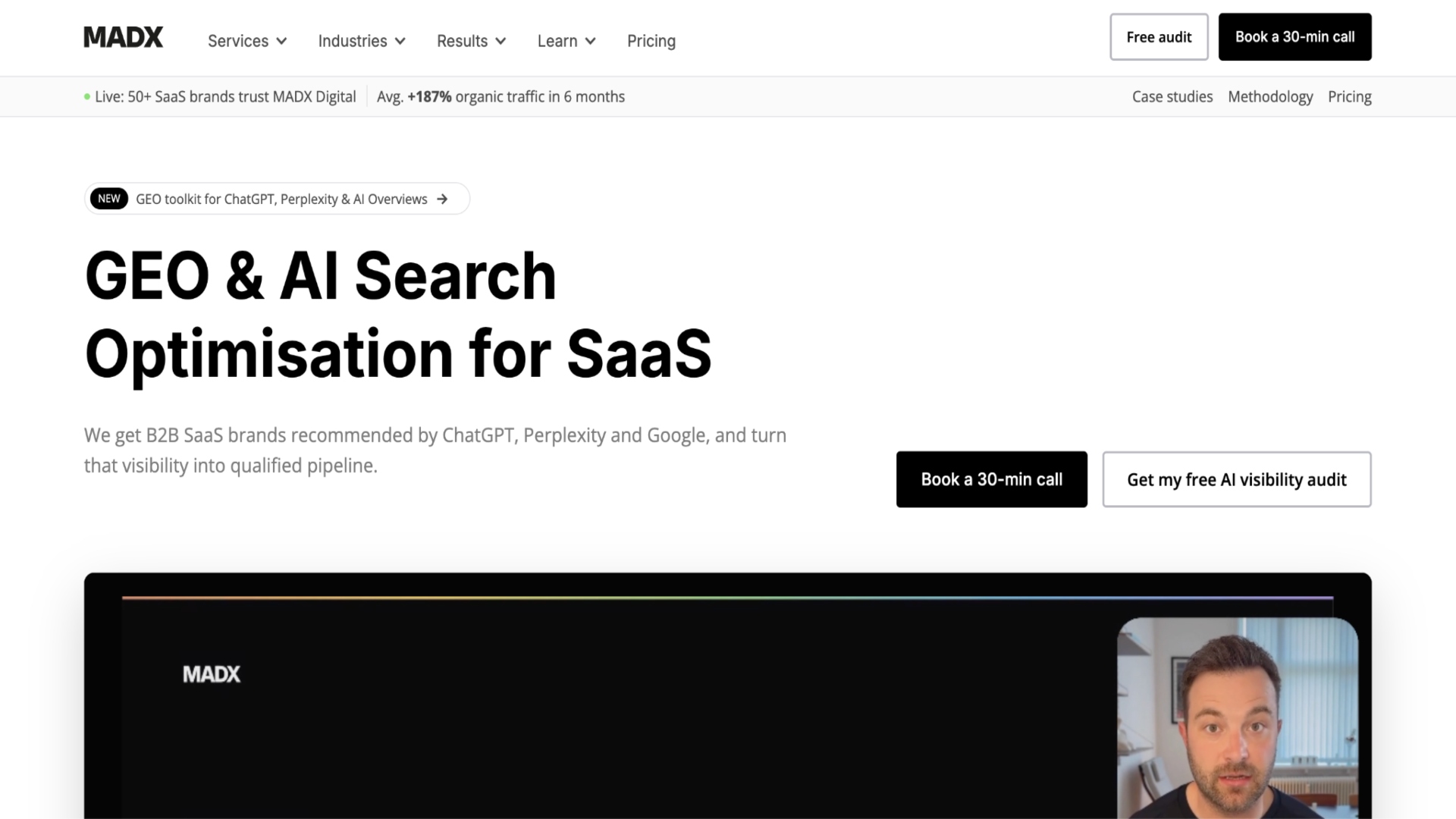
MADX Digital is a B2B SaaS SEO and AI Search agency. It helps SaaS brands get found in Google and in AI answers (ChatGPT, Perplexity, AI Overviews) across the UK, Europe and the US. Its SaaS SEO strategy guide covers technical groundwork.
Best for: SaaS teams wanting SEO and AI search run as one programme.
2. Skale
Skale is a London-based organic growth agency for B2B SaaS and tech companies, founded in 2019. It positions itself as AI-search-first and reports on SQLs, pipeline and new MRR rather than traffic alone.
Best for: SaaS companies that want SEO measured against revenue targets.
3. Omnius
Omnius is a Europe-based SEO and AI search agency that works only with SaaS and fintech companies. Its services span technical SEO, content and answer engine optimisation, and its published work includes UK business account provider ANNA Money.
Best for: SaaS and fintech brands that need technical and content work together.
4. Breaking B2B
Breaking B2B is a UK agency founded by Sam Dunning, who also hosts the Breaking B2B podcast on SaaS and B2B marketing. It combines B2B SEO with website design under a focus on revenue rather than vanity metrics.
Best for: B2B tech companies that need SEO and a website rebuild together.
Conclusion
SaaS SEO works best as one system: a site that crawlers can read, content that answers real buying questions, credible mentions on the sources buyers and AI assistants consult, and reporting that ties visibility to pipeline. Start with the technical foundations and bottom-of-funnel pages, review progress every quarter, and bring in specialist help where your team lacks the time or skills.
FAQ
How long does SaaS SEO take to show results?
Technical fixes can affect visibility within weeks, while content and authority work usually takes several months to build. Agree on leading indicators, such as impressions and AI citations, alongside pipeline targets.
Do SaaS companies need an llms.txt file?
Not for Google. Google’s documentation states that Google Search ignores llms.txt files, so they neither help nor harm visibility there. Other platforms publish their own guidance.
Can I appear in ChatGPT search without allowing model training?
Yes. OpenAI documents OAI-SearchBot for search and GPTBot for potential training as separate settings, so you can allow one and block the other. Appearing in ChatGPT search is still not guaranteed.
Should a SaaS startup hire an agency or build in-house?
Early-stage teams often start with a freelancer or agency for strategy and technical setup, then hire in-house as content needs become steady. The right answer depends on budget, engineering support and how quickly you need results.
Popular Articles




The Biggest Myths Founders Believe About Scaling
17th November 2026 · 4 min read
Why Your Business Strategy Could Fail Tomorrow: Scott Steinberg on Preparing for Disruption
17th November 2026 · 4 min read
The Biggest Legal Issues Seen During Corporate Growth
2nd November 2026 · 2 min read
Top 8 Ways To Increase Your Business Visibility Online
30th September 2022 · 6 min read
Article Categories
You Might Also Like
How SMEs Can Build a More Efficient Lead Management Process

How to Keep Teams Aligned on Strategic Goals
Aligning teams with strategic goals transforms executive vision into concrete business outcomes. Every successful organization relies on clear pathways between boardroom strategy and employee activities that advance company objectives. Achieving l...
28th September 2026 · 4 min read
Shop With a Flat Above on One Water Supply? What Splitting It Involves
A shop, café or takeaway downstairs with a flat upstairs is a familiar setup for small business owners and landlords. What is less obvious is that the two units may share a single water supply. Wave Utilities, a water retailer, notes that a...
8th October 2026 · 5 min read